Introduction
Freshwater scarcity is one of the most pressing global challenges of the 21st century. With over 70% of Earth’s surface covered by water, it seems paradoxical that billions lack access to safe drinking water. The reason? Most of it about 97% is saltwater. Traditional desalination technologies have provided a solution but often at a steep environmental and economic cost.
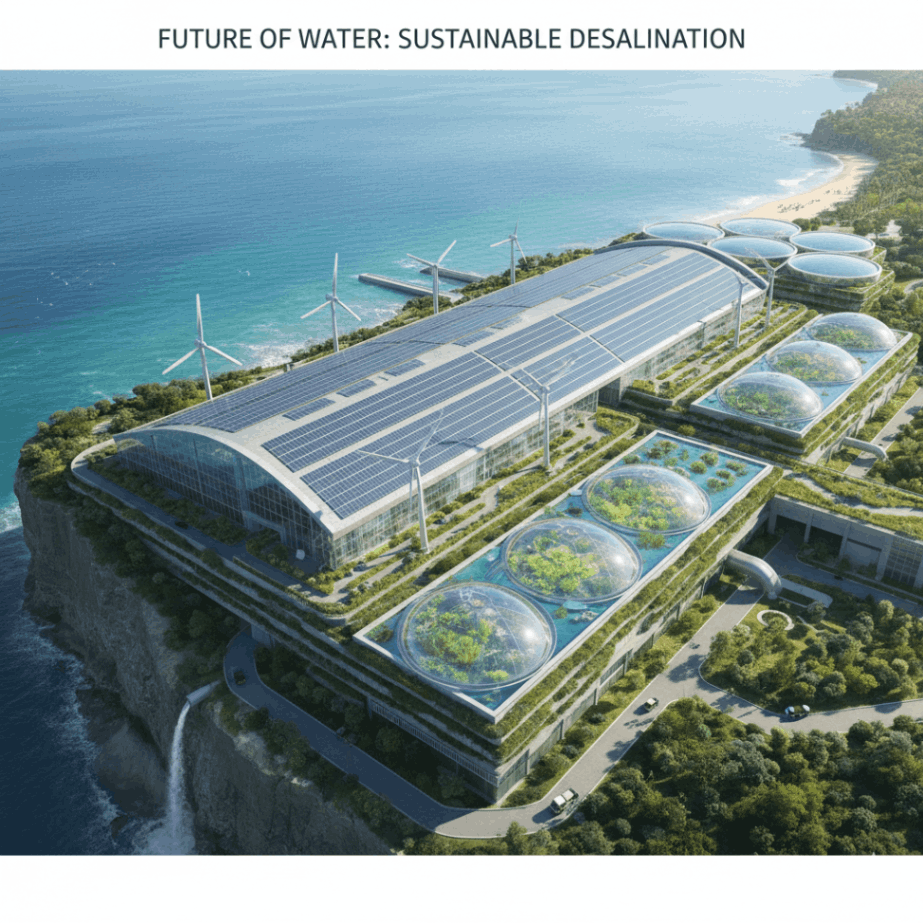
Enter Desalination 2.0 a new wave of sustainable, energy-efficient, and eco-friendly methods designed to transform how we turn seawater into safe, drinkable water.
This article explores the evolution of desalination, emerging sustainable innovations, and their role in addressing global water shortages.
The Growing Global Water Crisis
Water scarcity affects over 2 billion people globally, according to the World Health Organization (WHO). Rapid urbanization, population growth, and climate change have exacerbated the demand-supply gap. Regions such as the Middle East, North Africa, and parts of Asia are particularly vulnerable.
Key Statistics:
| Indicator | Value |
|---|---|
| Percentage of Earth’s water that is saltwater | 97% |
| Global population facing water stress | 2.2 billion |
| Annual growth rate of water demand | 1% |
| Projected water deficit by 2030 | 40% shortfall |
As groundwater levels decline and rivers dry up, desalination offers a viable path forward — but it needs to be sustainable.
Understanding Traditional Desalination
Before delving into Desalination 2.0, it’s essential to understand traditional methods and their limitations.
Common Traditional Techniques
-
Reverse Osmosis (RO)
-
Uses semi-permeable membranes to remove salts and impurities.
-
Energy-intensive due to high pressure requirements.
-
-
Thermal Distillation (MSF & MED)
-
Involves heating seawater and condensing vapor into freshwater.
-
Extremely energy-consuming and reliant on fossil fuels.
-
Challenges
-
High energy consumption (up to 15 kWh/m³).
-
Brine disposal, which harms marine ecosystems.
-
Carbon emissions from fossil-fueled plants.
-
High operational and maintenance costs.
These issues have motivated researchers and governments to seek greener alternatives giving rise to Desalination 2.0.
What is Desalination 2.0?
Desalination 2.0 refers to the next generation of desalination technologies that emphasize sustainability, energy efficiency, and environmental protection. It integrates renewable energy, smart materials, and advanced filtration techniques to minimize ecological impact while improving scalability.
Core Features of Desalination 2.0
-
Powered by solar, wind, or geothermal energy.
-
Utilizes nanotechnology and graphene membranes for higher efficiency.
-
Implements zero-liquid discharge (ZLD) systems to reduce waste.
-
Focuses on energy recovery and circular water systems.
Sustainable Technologies Driving Desalination 2.0
Let’s explore the groundbreaking innovations shaping this sustainable revolution:
1. Solar-Powered Desalination
-
Uses photovoltaic panels or solar thermal energy to power desalination plants.
-
Reduces dependency on fossil fuels.
-
Particularly effective in sun-rich regions like the Middle East and Africa.
Example:
The Mohammed bin Rashid Al Maktoum Solar Park in Dubai integrates solar desalination to supply sustainable drinking water.
2. Graphene-Based Membranes
Graphene’s atomic thinness and strength make it a game-changer for desalination.
Advantages:
-
Faster filtration and lower energy use.
-
Less fouling compared to polymer membranes.
-
Extended lifespan, reducing maintenance costs.
Research Insight:
According to a 2024 study in Nature Nanotechnology, graphene oxide membranes can filter seawater up to 10 times faster than traditional RO membranes.
3. Forward Osmosis (FO)
This process uses osmotic pressure differences to draw water through a semi-permeable membrane.
Benefits:
-
Requires less energy than reverse osmosis.
-
Works efficiently at low temperatures.
-
Produces high-quality freshwater with minimal brine waste.
4. Zero-Liquid Discharge (ZLD) Systems
ZLD systems ensure no liquid waste leaves the plant.
Key Advantages:
-
Converts waste brine into usable salts or minerals.
-
Protects marine ecosystems.
-
Aligns with circular economy principles.
5. AI and IoT in Desalination
Smart monitoring and automation optimize performance.
Applications:
-
Predictive maintenance reduces downtime.
-
Real-time sensors track salinity and energy efficiency.
-
AI-driven control systems fine-tune pressure and flow rates for maximum output.
Comparative Overview: Traditional vs Desalination 2.0
| Feature | Traditional Desalination | Desalination 2.0 |
|---|---|---|
| Energy Source | Fossil fuels | Renewable (solar, wind, geothermal) |
| Efficiency | Moderate | High |
| Environmental Impact | High (brine waste) | Low (ZLD, eco-safe) |
| Cost | High operational costs | Lower over time |
| Technology Type | Reverse Osmosis, Thermal | Graphene membranes, AI-powered systems |
| Sustainability | Low | High |
Global Leaders in Sustainable Desalination
Several countries are leading the charge toward Desalination 2.0.
1. Saudi Arabia
-
Home to NEOM’s Solar Desalination Plant, powered 100% by renewable energy.
-
Focus on zero-carbon water solutions for its futuristic city project.
2. Singapore
-
Employs hybrid desalination plants integrating RO and renewable energy.
-
Aims to achieve water self-sufficiency by 2060.
3. Australia
-
Utilizes wind-powered desalination plants to serve urban and rural communities sustainably.
Environmental and Economic Impacts
Desalination 2.0 technologies are transforming both environmental outcomes and economic models.
Environmental Benefits
-
Reduction in carbon footprint by using renewables.
-
Brine valorization turns waste into industrial resources.
-
Improved biodiversity protection through eco-safe discharge methods.
Economic Advantages
-
Lower operational expenses over time due to energy efficiency.
-
Creation of green jobs in clean energy and water tech.
-
Boost to industrial and agricultural productivity in arid regions.
Challenges and Future Outlook
Despite its promise, Desalination 2.0 faces some challenges:
-
Initial investment costs for advanced systems.
-
Membrane degradation and fouling issues.
-
Need for policy frameworks supporting renewable desalination.
Future Prospects
-
AI-driven water optimization across entire grids.
-
Hybrid desalination plants combining solar, wind, and tidal energy.
-
Integration with water recycling and hydrogen production systems for full sustainability.
By 2035, experts predict 50% of global desalination capacity will operate on renewable energy sources signaling a major shift toward sustainable water access.
FAQs
1. What makes Desalination 2.0 different from traditional desalination?
Desalination 2.0 focuses on sustainability and energy efficiency by using renewable energy and advanced filtration systems, unlike conventional methods that rely heavily on fossil fuels.
2. Is solar desalination cost-effective?
Yes. While initial setup costs are higher, solar desalination drastically reduces long-term operational expenses and environmental impact.
3. How does AI improve desalination efficiency?
AI systems monitor plant operations in real time, predicting maintenance needs and optimizing energy use, resulting in lower costs and higher output.
4. Can desalination 2.0 solve global water scarcity?
It’s a significant part of the solution, especially when combined with water recycling, conservation, and efficient distribution systems.
5. What are the future trends in desalination technology?
Expect graphene membranes, hybrid renewable systems, and AI-integrated water networks to dominate future desalination innovations.
Conclusion
Desalination 2.0 represents the next frontier in sustainable water innovation. By merging clean energy, nanotechnology, and AI, it addresses the shortcomings of traditional methods and paves the way for a world where seawater becomes an accessible, eco-friendly source of life.
As global demand for freshwater continues to rise, embracing sustainable desalination will be vital for achieving long-term water security and environmental harmony.