Introduction
Access to credit has always been a challenge for smallholder farmers, especially in rural regions where traditional banking systems fail to reach. Conventional loan scoring models rely heavily on financial history, collateral, and formal documentation, which many farmers lack. This exclusion leaves millions of agricultural workers without access to micro-loans that could significantly improve their livelihoods.
Enter AI micro-loan scoring powered by satellite imagery for crop yield estimation—a revolutionary approach that combines financial technology, artificial intelligence, and earth observation data to provide fairer, faster, and more reliable credit scoring for farmers.
In this article, we will explore how this technology works, its benefits, challenges, real-world applications, and its role in reshaping agri-fintech ecosystems worldwide.
Why Traditional Loan Scoring Fails in Agriculture
Farmers face unique challenges that traditional credit systems struggle to capture:
-
Lack of formal financial history Most farmers operate outside formal banking systems.
-
Collateral limitations Land ownership disputes and lack of legal documentation make collateral-based loans difficult.
-
High default risk perception Lenders see agriculture as risky due to unpredictable climate, pest attacks, and market volatility.
-
Limited transparency Crop yields are difficult to predict without modern data-driven tools.
These barriers leave billions in potential agricultural credit untapped. This is where AI-driven satellite imagery scoring steps in as a solution.
The Role of AI in Micro-loan Scoring
Artificial Intelligence allows financial institutions to go beyond traditional credit checks by analyzing non-financial data sources such as:
-
Crop growth patterns
-
Soil health
-
Weather conditions
-
Historical yield performance
By processing satellite imagery and ground-level data, AI models can generate predictive scores that represent a farmer’s ability to repay a loan.
Benefits of AI Loan Scoring
-
Data-driven fairness Loans are issued based on actual crop productivity, not financial history.
-
Faster approvals Automated scoring reduces processing time.
-
Lower risks for lenders Predictive analytics minimize defaults.
-
Financial inclusion Farmers without bank records gain access to micro-loans.
How Satellite Imagery Supports Crop Yield Estimation
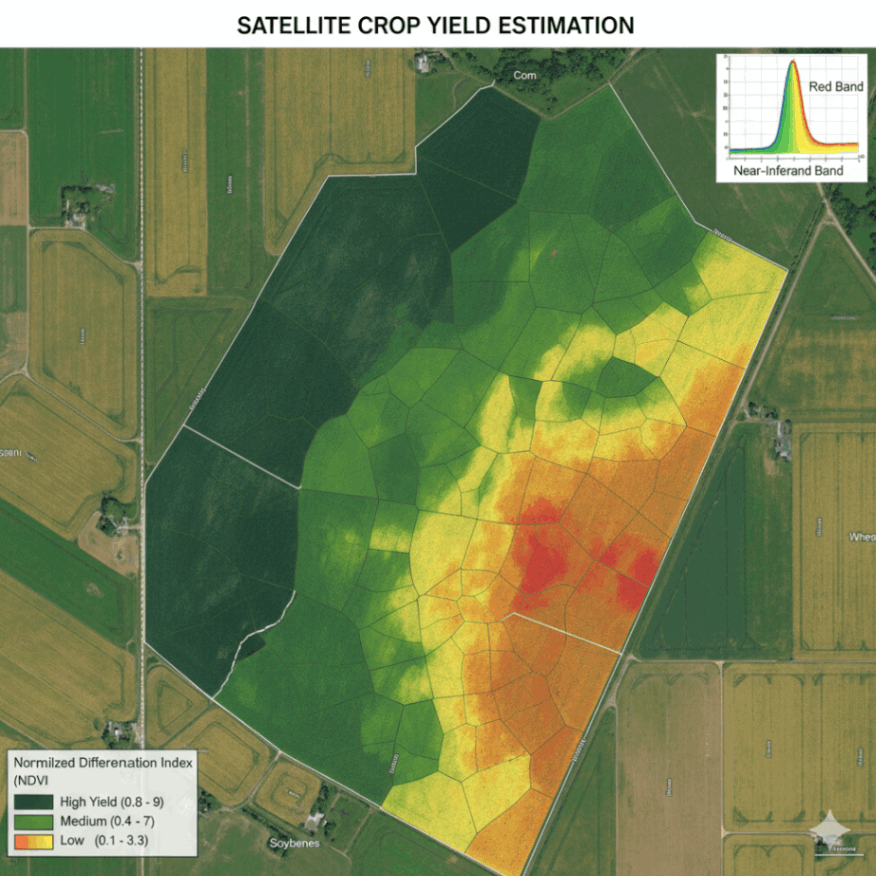
Satellite imagery provides real-time, large scale, and cost effective agricultural data. It captures crucial information on crop health, growth cycles, and soil conditions.
Key Techniques Used
-
Normalized Difference Vegetation Index (NDVI):
Measures vegetation health by analyzing light reflected from crops. -
Synthetic Aperture Radar (SAR):
Tracks soil moisture and land usage patterns, even during cloudy conditions. -
Multispectral & Hyperspectral Imaging:
Identifies crop stress, diseases, and nutrient deficiencies. -
Time-series Analysis:
Compares historical and current yield data for more accurate loan predictions.
Framework: AI-Powered Micro-loan Scoring Workflow
Here’s a simplified process of how fintech platforms use AI with satellite data:
| Step | Process | Impact |
|---|---|---|
| Data Collection | Satellite imagery, local weather data, IoT sensors, and farmer profiles | Builds farmer-specific datasets |
| AI Modeling | Machine learning models analyze crop health, soil fertility, and yield | Creates risk-adjusted credit scores |
| Loan Decision | Microfinance institutions use AI scores to approve or reject loans | Reduces bias and increases inclusivity |
| Loan Monitoring | Satellites track crop progress throughout the season | Early detection of risks for lenders |
| Repayment Prediction | Predictive analytics estimate farmer income and repayment ability | Improves trust and reduces default rates |
Global Examples of AI Micro-loan Scoring
Several fintech and agri-tech startups have already started implementing this innovation:
-
Apollo Agriculture (Kenya): Uses AI and satellite data to provide credit and inputs to farmers.
-
SatSure (India): Offers risk intelligence for financial institutions based on satellite imagery.
-
AgriPredict (Zambia): Combines satellite data with AI to predict crop diseases and improve loan scoring.
These examples show how technology bridges the gap between farmers and lenders.
Advantages for Farmers and Lenders
For Farmers:
-
Access to loans without formal banking history
-
Lower interest rates due to improved risk analysis
-
Support in adopting modern farming techniques
For Lenders:
-
Expanded customer base in rural areas
-
Reduced risk of defaults
-
Real-time monitoring of financed crops
Challenges & Risks
Despite its potential, there are challenges to adopting AI-driven loan scoring:
-
Data Privacy Concerns Farmers must consent to data usage.
-
High Initial Costs Setting up AI and satellite infrastructure is expensive.
-
Digital Divide Rural farmers may lack access to mobile devices or internet.
-
Model Bias AI algorithms need constant updates to avoid bias.
Future of AI & Satellite-based Microfinance
The future looks promising as fintech integrates blockchain, IoT, and digital wallets with AI-powered satellite scoring. Farmers will not only access credit but also receive insurance, market insights, and sustainable farming recommendations.
Governments and institutions like the World Bank are increasingly supporting such innovations for financial inclusion and food security.
Frequently Asked Questions (FAQ)
1. How does AI improve micro-loan scoring for farmers?
AI analyzes satellite imagery, weather data, and historical yield patterns to assess repayment capacity, making loan approvals more accurate and inclusive.
2. Can farmers without financial history get loans through this method?
Yes. Since AI uses agricultural data instead of banking history, farmers without traditional credit records can access micro-loans.
3. What role do satellites play in crop yield estimation?
Satellites monitor vegetation health, soil moisture, and crop growth, helping lenders predict yields and reduce risks.
4. Are there risks of bias in AI loan scoring?
Yes. If not trained on diverse datasets, AI may create biases. Continuous monitoring and regulatory frameworks are essential.
5. Which countries are leading in this innovation?
Kenya, India, and Zambia are notable examples, with startups and fintech firms driving satellite-based credit scoring adoption.
Conclusion
AI micro-loan scoring using satellite imagery for crop yield estimation is not just a technological breakthrough it is a financial inclusion revolution. By leveraging AI-driven insights, fintech platforms are ensuring that farmers, especially in rural communities, gain fair access to credit.
This innovation empowers farmers with better financing, reduced risks, and sustainable agricultural growth, while offering lenders a more reliable way to manage agricultural credit portfolios.
The integration of AI, satellite data, and fintech is paving the way for a future where every farmer, regardless of financial background, has access to opportunities for growth.