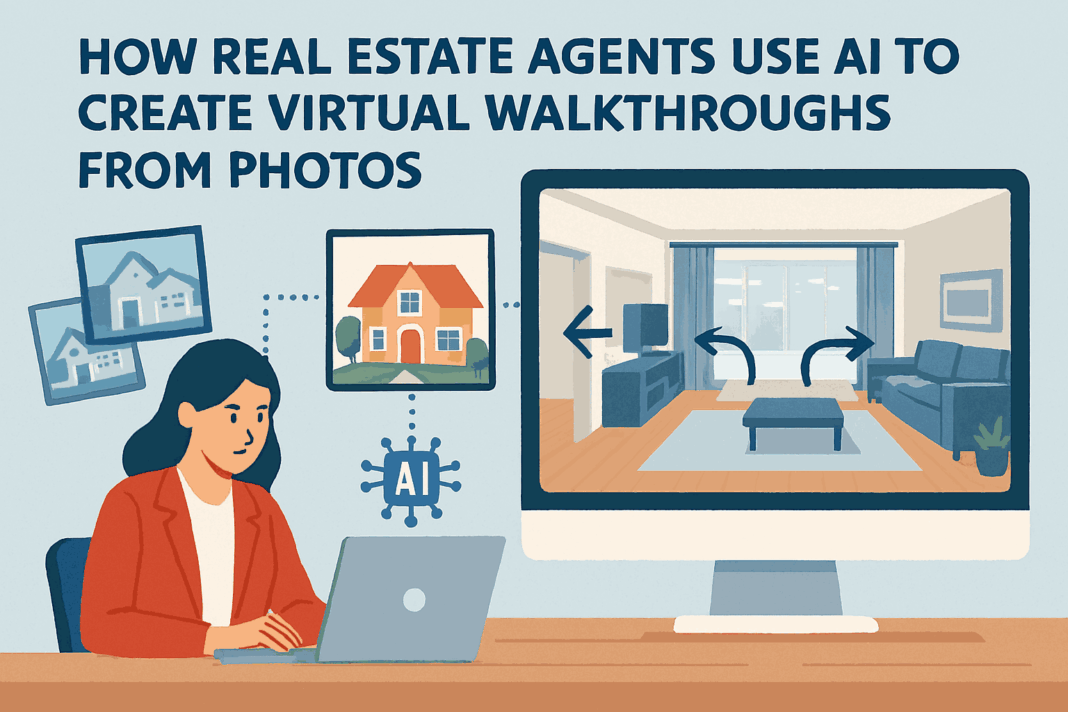
The real estate industry has changed dramatically in the last few years, especially as buyers expect to explore properties digitally before ever stepping inside. While traditional video tours and 3D mapping once required costly equipment or professional crews, artificial intelligence is now making virtual walkthroughs accessible to agents at every level. One of the biggest breakthroughs is the ability to generate smooth, realistic property videos using only photos. This technology gives agents a powerful way to market listings, attract remote buyers, and stand out in a crowded marketplace.
AI is not replacing the core skills of selling homes, but it is helping agents create visual experiences that feel richer, more immersive, and more informative than static photos alone. With buyers spending more time browsing online listings, the demand for high quality digital visuals will only continue to grow.
Why are virtual walkthroughs becoming essential in real estate?
Virtual walkthroughs are becoming essential because buyers expect more than photos when evaluating homes online. A study from the National Association of Realtors found that 73 percent of buyers consider video tours very important in their decision making. Remote and out of state buyers rely heavily on virtual content, and many prefer seeing layout flow rather than clicking through still images.
Walkthrough videos also help listings stand out on platforms like Zillow, Instagram, and YouTube. Real estate marketing experts consistently report that video content increases engagement by up to 300 percent compared to static images. When buyers can visualize themselves moving through a property, they form stronger emotional connections and inquire more quickly.
For agents, the appeal goes beyond marketing. Virtual walkthroughs save time by filtering out buyers who are not serious, while attracting those who are already excited before the viewing. As competition increases, agents need tools that help them communicate value instantly.
How does AI turn photos into realistic virtual walkthroughs?
AI takes ordinary property photos and transforms them into dynamic motion sequences by analyzing the space and predicting the most natural movement through it. Instead of needing physical video footage, AI models re create transitions, simulate depth, and generate smooth pan or dolly style movements that mimic professional filming.
The process usually involves:
- Identifying edges, shapes, and room structure
• Estimating depth between foreground and background
• Reconstructing missing visual areas where transitions occur
• Generating new frames that blend one photo into the next
This allows a simple photo set to feel like a guided tour rather than a slideshow.
Many agents rely on an ai video generator from image by Viggle AI to create these walkthroughs because it automates motion design and produces visually clean results without requiring professional editing. With the growing need for digital property presentations, AI tools like this make it possible for agents to produce immersive visuals in minutes instead of hours.
What types of properties benefit most from AI virtual walkthroughs?
Although any listing can benefit from enhanced visual storytelling, certain types of properties see especially strong results when AI walkthroughs are used.
Vacant homes
Buyers often struggle to understand flow when rooms are empty. AI motion helps them better interpret proportions and layout.
Luxury listings
High end properties attract out of region buyers who rely on virtual tours before scheduling in person visits.
Pre construction or renovation projects
Still photos or design concepts can be animated to give buyers a sense of what the finished space will feel like.
Short term rentals
Hosts on platforms like Airbnb or Vrbo use these videos to showcase amenities and increase booking confidence.
Small or uniquely shaped spaces
AI walkthroughs help illustrate how rooms connect in a way photos rarely can.
The more a buyer needs help visualizing how a property lives, the more value an AI generated walkthrough provides.
How do AI walkthroughs impact buyer engagement and conversion?
AI generated walkthroughs improve engagement in measurable ways. According to listing analytics from major real estate platforms, homes with video tours receive significantly more clicks, shares, and saves. In many markets, properties with walkthroughs sell faster because buyers gain clarity earlier in the process.
There are several reasons these videos convert so well:
They show layout flow.
Many buyers say layout matters more than decor. Walkthrough videos reveal how rooms connect, something photos rarely communicate clearly.
They increase emotional connection.
Movement creates immersion, which helps buyers imagine daily life in the home.
They reduce uncertainty.
Buyers hesitate when they cannot visualize a space. Removing that uncertainty leads to quicker inquiries.
They attract remote buyers.
Out of state moves have increased sharply in recent years. Virtual walkthroughs help make decisions without multiple flights or in person visits.
As more buyers begin their searches online, these videos will play an even bigger role in the top of the sales funnel.
Can AI walkthroughs replace traditional filming entirely?
AI walkthroughs will not replace professional video filming in every situation, but they significantly reduce the need for on site shoots, especially for everyday listings. Traditional filming still provides benefits for large estates, complex architecture, or properties that depend on ambiance and live action moments like ocean views or neighborhood scenes.
However, AI offers major advantages:
- No need for expensive equipment
• No scheduling around lighting or weather
• No reshoots
• Faster production timelines
• Lower cost for agents
For mid range listings, rental properties, and new agent portfolios, AI walkthroughs are fast becoming a preferred alternative. They provide a high quality viewing experience at a fraction of the effort.
In many cases, agents are combining both methods: using AI for initial marketing and professional filming for premium listings or final campaigns.
What does this shift mean for the future of real estate marketing?
The rise of AI generated virtual walkthroughs signals a broader transformation in how real estate visuals are produced. Instead of large production budgets and long turnaround times, agents can now create compelling videos from a single photo set. As AI models continue to improve depth accuracy, lighting simulation, and scene prediction, virtual tours will look even more natural.
This shift also democratizes marketing. New agents, small brokerages, and independent realtors can now compete visually with high budget teams. Listings become more appealing, buyers stay engaged longer, and sellers gain confidence knowing their homes are being presented at a high standard.
In the long term, AI may enable interactive walkthroughs, customizable tours, or even full 3D visualizations created directly from mobile phone photos. The industry is moving quickly, and agents who adopt these tools early will stand out in a rapidly evolving marketplace.
Conclusion
AI is changing the way real estate agents showcase properties, making virtual walkthroughs faster, easier, and more accessible than ever. With the ability to turn simple photos into dynamic videos, agents can tell more compelling visual stories and reach buyers who depend on rich digital experiences. These tools increase engagement, improve buyer understanding, and support stronger marketing outcomes without requiring professional filming.
As AI continues to advance, virtual walkthroughs will become a standard expectation rather than a premium feature. For agents looking to stay competitive, embracing this technology today is the first step toward building a future ready real estate business.