Introduction
The month of Rabi ul Awwal holds immense significance for Muslims worldwide as it marks the blessed birth of Prophet Muhammad (PBUH). Traditionally, Muslims celebrate this month with Milad gatherings, Seerat conferences, lectures, and community events.
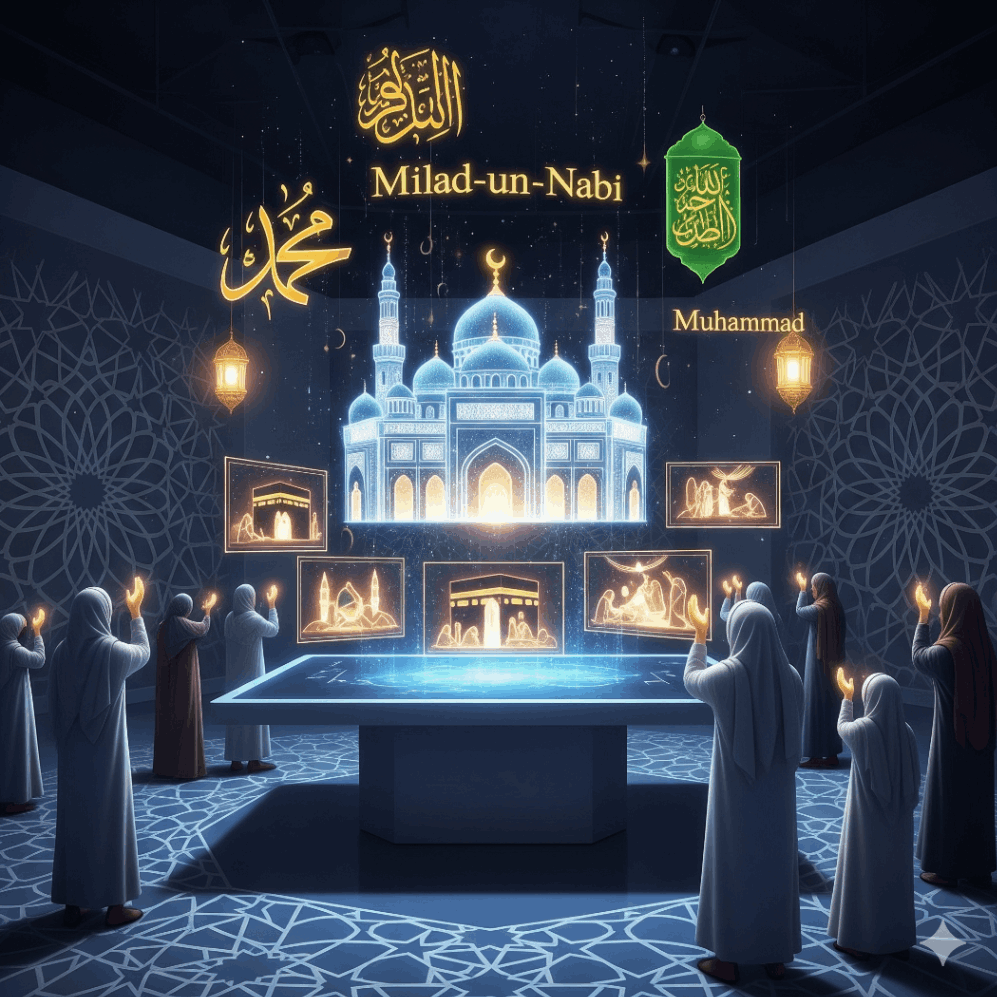
In today’s digital-first era, a new dimension has emerged Virtual Reality (VR) and the Metaverse. These technologies are enabling Muslims to experience Seerat un Nabi (PBUH) interactively, making Islamic knowledge more engaging and accessible across the globe.
This article explores how VR and the Metaverse can reshape Rabi ul Awwal celebrations, offering unique opportunities for education, spiritual connection, and community building.
Why Use Virtual Reality in Rabi ul Awwal?
Virtual Reality allows believers to step into an immersive environment, making learning about the Prophet’s (PBUH) life more memorable and engaging. Instead of just reading or listening, users can virtually experience:
-
Historic events such as the Prophet’s (PBUH) journey to Madinah.
-
3D recreations of Mecca and Madinah during the Prophet’s time.
-
Interactive Seerah lessons that feel like a personal journey through history.
Example: Imagine a Muslim student in Pakistan wearing a VR headset and experiencing the House of Arqam, where early Muslims secretly gathered to learn Islam.
The Role of the Metaverse in Digital Celebrations
The Metaverse is not just a virtual world it’s a shared digital space where millions of people can join simultaneously. For Rabi ul Awwal, this opens new opportunities:
-
Virtual Milad Gatherings Muslims from around the world joining a digital mosque.
-
Interactive Seerah Exhibitions Walkthroughs of historical timelines in 3D.
-
Global Unity Breaking geographical barriers for collective remembrance.
This aligns with the Islamic principle of Ummah unity, as the Metaverse enables Muslims from diverse backgrounds to celebrate together.
Educational Impact: Learning Seerat un Nabi (PBUH) Digitally
Digital tools like VR and Metaverse bring Seerat un Nabi (PBUH) education to life. Some benefits include:
-
Engagement for Youth: Younger generations find immersive learning more appealing than traditional methods.
-
Global Accessibility: Muslims in non-Muslim countries can participate in Rabi ul Awwal events virtually.
-
Multi-language Support: VR environments can provide translations for diverse audiences.
Table: Traditional vs. Digital Learning of Seerah
| Aspect | Traditional Learning | VR/Metaverse Learning |
|---|---|---|
| Method | Lectures, books, events | Immersive 3D experience |
| Accessibility | Local gatherings only | Global participation |
| Engagement Level | Passive listening | Interactive involvement |
| Language Barriers | Limited to speaker’s language | Multi-language support |
| Memory Retention | Moderate | High (visual + emotional connection) |
Real-World Examples of VR in Islamic Learning
Some initiatives already use VR and Metaverse in religious education:
-
VR Islamic Museums: Digital museums showcasing artifacts from Islamic history.
-
Quranic VR Apps: Interactive recitations with visualized contexts.
-
Virtual Hajj Training: Apps guiding pilgrims on how to perform Hajj rituals.
If similar efforts are applied to Rabi ul Awwal, Muslims can digitally attend Seerah exhibitions or Prophetic timeline walkthroughs.
For instance:
-
A Virtual Exhibition of the Prophet’s (PBUH) family lineage.
-
A Digital Map of Hijrah (Migration) route with interactive points.
Addressing Concerns and Challenges
While the idea of celebrating Seerat un Nabi (PBUH) through VR and the Metaverse is innovative, it comes with concerns:
-
Authenticity of Information: Scholars must validate all content.
-
Over-reliance on Technology: Should complement, not replace, traditional gatherings.
-
Accessibility Costs: VR devices are expensive for many communities.
Scholars and technologists must collaborate to ensure authentic, respectful, and accessible use of VR in Islamic contexts.
Future Outlook: The Digital Transformation of Rabi ul Awwal
The use of VR and Metaverse in Rabi ul Awwal will likely expand in the coming years. Possible developments include:
-
Metaverse Mosques: Spaces for global Seerah lectures.
-
AI-powered Seerah Guides: Virtual assistants narrating events from the Prophet’s (PBUH) life.
-
Gamified Seerah Learning: Interactive challenges to enhance understanding.
This shift can inspire youth engagement while preserving Islamic values in the digital age.
Frequently Asked Questions (FAQ)
1. Can VR be used to teach Seerat un Nabi (PBUH) responsibly?
Yes, but it requires close collaboration with Islamic scholars to ensure authentic and respectful content.
2. Will VR replace traditional Rabi ul Awwal gatherings?
No. It should serve as a complementary tool, especially for Muslims who cannot attend physical events.
3. Is it permissible to use the Metaverse for Islamic education?
As long as the content respects Islamic principles and avoids misrepresentation, many scholars consider it a useful educational tool.
4. What are the main benefits of digital Seerah learning?
-
Wider accessibility
-
Stronger engagement
-
Language diversity support
-
Higher memory retention
5. How can communities without VR access benefit?
Even without headsets, web-based Metaverse platforms allow participation through smartphones or PCs.
Conclusion
The combination of Virtual Reality and the Metaverse provides Muslims with an unprecedented opportunity to experience Seerat un Nabi (PBUH) during Rabi ul Awwal in a more engaging, global, and inclusive way. While challenges exist, with proper guidance and authenticity checks, these technologies can transform how Muslims worldwide celebrate this blessed month.
As the digital world evolves, Rabi ul Awwal celebrations may expand from local mosques to global virtual gatherings, strengthening the unity of the Ummah in innovative ways.