Introduction
The year 2025 marks a historic chapter in space exploration. With cutting-edge telescopes, international collaborations, and advanced artificial intelligence, humanity is uncovering secrets of the cosmos like never before. From new exoplanet discoveries to revolutionary findings about black holes and dark matter, the breakthroughs of 2025 are redefining how we see the universe.
In this article, we will explore the most important space discoveries of 2025, their significance for science and technology, and what they mean for the future of humankind.
Why Space Discoveries in 2025 Matter
Space exploration has always been more than just science it’s about innovation, survival, and inspiration. The discoveries of 2025 are crucial because:
-
They expand our understanding of planetary habitability.
-
They improve space technology and AI-driven research.
-
They strengthen international collaborations through projects like NASA’s Artemis program and ESA’s ExoMars missions.
-
They inspire new industries in space mining, tourism, and defense.
Major Space Discoveries of 2025
1. Discovery of Earth-like Exoplanets
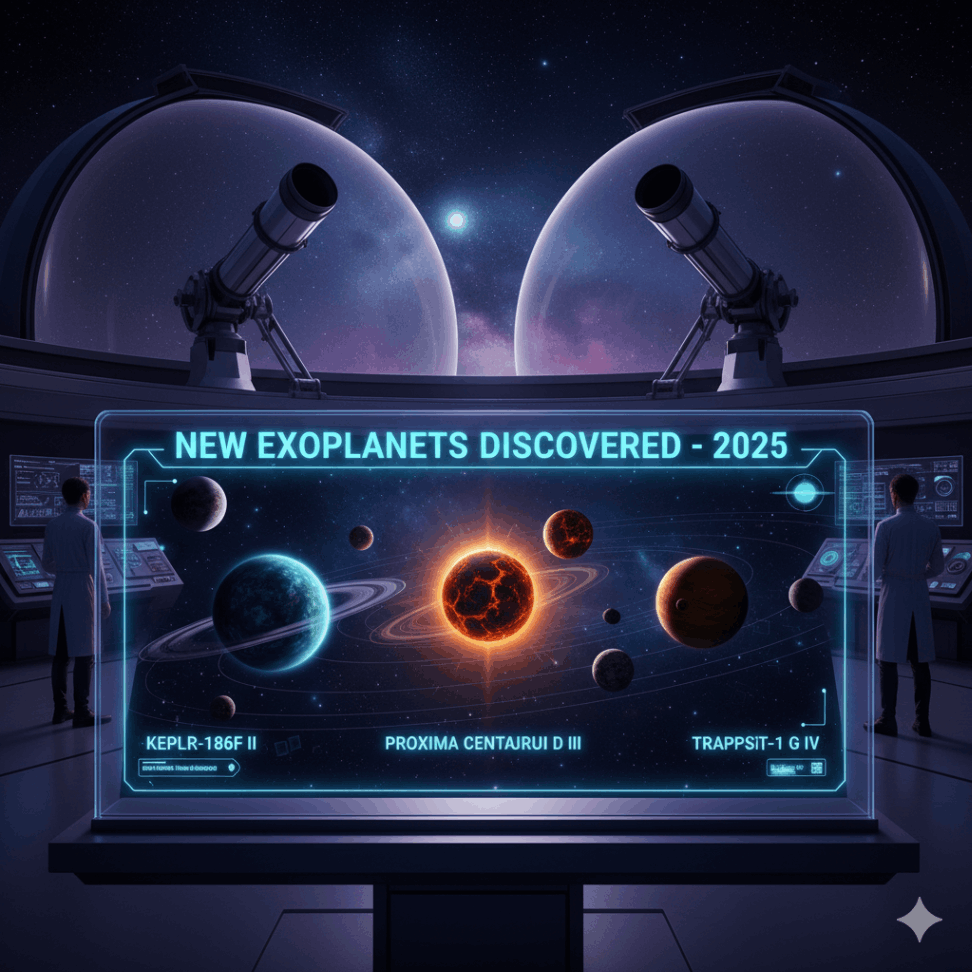
Astronomers using the James Webb Space Telescope (JWST) and the European Extremely Large Telescope (E-ELT) have confirmed five Earth-sized exoplanets within habitable zones. Two of these planets show possible atmospheric oxygen and water vapor, raising the question of potential microbial life.
Key Highlights:
-
Planets discovered around stars in the Kepler-442 system.
-
One planet, Kepler-442c II, has an atmosphere that resembles early Earth.
-
Potential candidates for future interstellar missions.
2. First Real-Time Black Hole Observation
In 2025, scientists achieved a breakthrough by capturing real-time changes in a black hole’s accretion disk. The Event Horizon Telescope (EHT) and radio telescopes worldwide synchronized to create a live model of black hole dynamics.
Impact:
-
Helps us understand gravitational waves.
-
Validates Einstein’s General Relativity in extreme conditions.
-
Opens doors for future quantum gravity theories.
3. Dark Matter Mapping Achievements
The Euclid Space Telescope, launched by the European Space Agency (ESA), created the most detailed 3D map of dark matter. This mapping may answer long-standing questions about the missing mass of the universe.
Benefits of Dark Matter Mapping:
-
Better understanding of galaxy formation.
-
Foundation for new cosmological models.
-
May provide insights into alternative energy sources.
4. Breakthrough in Lunar Discoveries
As part of NASA’s Artemis III program, astronauts returned to the Moon in 2025. They discovered water ice deposits in deeper craters than previously believed. This discovery is critical for future lunar colonization.
Why It Matters:
-
Water can be converted into oxygen and hydrogen fuel.
-
Supports sustainable lunar bases.
-
Reduces costs for deep space exploration.
-
5. Signs of Life on Europa
NASA’s Europa Clipper mission detected organic molecules and subsurface ocean activity on Jupiter’s moon Europa. These findings make Europa one of the most promising candidates for extraterrestrial microbial life.
Table: Top Space Discoveries of 2025
| Discovery | Mission/Source | Significance |
|---|---|---|
| Earth-like Exoplanets | JWST, E-ELT | Expands search for habitable worlds |
| Real-Time Black Hole Observation | Event Horizon Telescope | Validates Einstein’s relativity in extreme zones |
| Dark Matter Mapping | ESA Euclid Telescope | Explains galaxy formation & universe structure |
| Water Ice on the Moon | NASA Artemis III | Supports colonization & fuel production |
| Organic Molecules on Europa | NASA Europa Clipper | Boosts search for extraterrestrial life |
The Role of AI in Space Discoveries 2025
AI is a critical partner in astronomy. In 2025:
-
AI algorithms analyze petabytes of space data from telescopes.
-
Machine learning models detect planetary atmospheres faster.
-
Autonomous rovers and drones enhance lunar and Martian exploration.
This collaboration between AI and astronomy accelerates discoveries that would take decades using traditional methods.
For deeper insights into how AI impacts financial and technological systems, explore FinTech innovations.
Economic and Technological Implications
The discoveries of 2025 have wide-ranging impacts:
-
Space Economy Growth: Lunar water deposits may fuel the trillion-dollar space mining industry.
-
Technology Transfer: Innovations in telescopes and AI are improving earth-based industries like healthcare and finance.
-
Education and Inspiration: New discoveries inspire STEM research and global cooperation.
Challenges and Ethical Questions
While discoveries are exciting, they also raise questions:
-
Should we colonize planets before solving Earth’s challenges?
-
Who owns resources on the Moon and asteroids?
-
Could detecting life on Europa change religious or philosophical beliefs?
Global policies, like the Outer Space Treaty, will play a vital role in addressing these issues.
Frequently Asked Questions (FAQ)
1. What was the biggest space discovery of 2025?
The confirmation of multiple Earth-like exoplanets with oxygen-rich atmospheres is considered the most significant.
2. Why is water ice on the Moon important?
It enables oxygen production, drinking water supply, and rocket fuel creation, supporting long-term colonization.
3. What role did AI play in space discoveries in 2025?
AI accelerated data analysis, identified exoplanets, and improved mission planning.
4. Is there proof of life beyond Earth in 2025?
While microbial life has not been confirmed, Europa shows promising signs with organic molecules and ocean activity.
5. How do space discoveries impact Earth industries?
Discoveries drive technological innovations in AI, renewable energy, and communication, benefiting multiple industries.
Conclusion
The space discoveries of 2025 mark a turning point in human history. From exoplanets and black holes to lunar water and Europa’s organic molecules, these findings open new frontiers for science, technology, and human exploration.
As we move forward, one thing is certain: the universe is no longer a distant mysteryit’s the next great frontier for humanity.
For more insights into technology, innovation, and the future of finance in space exploration, visit FinTech Zoom IOM.