Introduction
Decentralized Finance (DeFi) is transforming how people access financial services by removing traditional intermediaries like banks and brokers. However, for first-time users in Asia, DeFi can be both exciting and risky.
While the promise of higher yields and financial independence attracts many newcomers, the decentralized nature of DeFi introduces unique vulnerabilities, especially for users unfamiliar with blockchain technology.
This guide breaks down the key risks and provides actionable tips to help you navigate the DeFi space safely.
What is DeFi?
DeFi, short for Decentralized Finance, refers to financial services built on blockchain networks like Ethereum, Solana, and Binance Smart Chain. It allows users to lend, borrow, swap, or earn interest on crypto assets without relying on traditional institutions.
Key components of DeFi include:
-
Smart Contracts: Self-executing code that automates transactions
-
Liquidity Pools: User-supplied funds used for decentralized exchanges
-
Yield Farming: Earning returns by providing liquidity
-
Stablecoins: Cryptocurrencies pegged to fiat currencies (e.g., USDT, USDC)
For a deep dive into DeFi mechanics, visit this guide from Investopedia.
Why DeFi is Gaining Popularity in Asia
Asia, especially countries like India, Pakistan, Vietnam, Indonesia, and the Philippines, has seen exponential growth in DeFi adoption due to:
-
High smartphone and internet penetration
-
Growing dissatisfaction with traditional banks
-
Limited access to global financial services
-
Increasing awareness of crypto assets
-
Attractive DeFi yields compared to local savings rates
Reports from Chainalysis highlight Asia as a hotspot for DeFi activity, particularly among young, tech-savvy users.
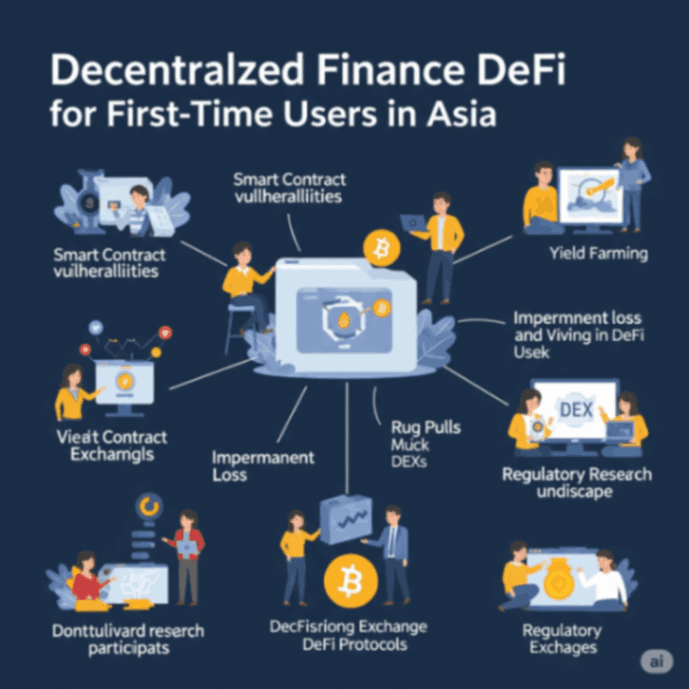
Major Risks in DeFi for Beginners
Before you dive in, here are major DeFi risks first-time users must understand:
1. Smart Contract Vulnerabilities
Smart contracts are the core of DeFi protocols. If poorly written, they can be exploited by hackers, resulting in loss of funds.
2. Impermanent Loss
Providing liquidity to pools may result in unexpected losses, especially if one of the tokens changes drastically in price.
3. Volatility of Crypto Assets
Cryptocurrencies are inherently volatile. Assets can drop significantly in value within minutes.
4. Rug Pulls
DeFi projects without reputation or audits may suddenly disappear, taking all user funds. This is known as a rug pull.
5. No Customer Support
Since DeFi is decentralized, there’s no help desk or refund mechanism if things go wrong.
6. High Gas Fees
On some blockchains like Ethereum, transaction fees (gas) can be prohibitively expensive during peak times.
7. Regulatory Uncertainty
Governments across Asia have mixed approaches to crypto, causing uncertainty for users.
Common Scams in the DeFi Space
Below are some of the most common DeFi scams that target new users:
| Scam Type | Description | How to Avoid |
|---|---|---|
| Rug Pulls | Developers abandon the project after raising funds | Stick to audited, well-known platforms |
| Phishing Attacks | Fake websites steal your seed phrases | Always double-check URLs and use bookmarks |
| Pump-and-Dump Schemes | Artificially inflating token prices to sell at a profit | Avoid unknown tokens or sudden price surges |
| Fake Airdrops | Asking for private keys in exchange for free tokens | Never share your private keys or seed phrases |
| Clone DApps | Copycat sites that mimic real DeFi platforms | Verify smart contract addresses on blockchain explorers like Etherscan |
New to DeFi? Here are essential precautions you must take:
-
Use Hardware Wallets: Store your assets offline using wallets like Ledger or Trezor
-
Never Share Seed Phrases: Keep your recovery phrases private and secure
-
Stick to Verified Platforms: Use DeFi projects audited by firms like CertiK or Hacken
-
Start Small: Don’t invest more than you can afford to lose
-
Read the Documentation: Understand how each protocol works before depositing funds
-
Enable Two-Factor Authentication (2FA): On wallets and exchange accounts
-
Monitor Gas Fees: Use tools like EthGasStation to save on transaction costs
Comparison Table: Traditional Finance vs DeFi
| Feature | Traditional Finance | DeFi |
|---|---|---|
| Intermediaries | Banks, brokers | None |
| Accessibility | Limited by location | Global |
| Transaction Time | Days | Minutes |
| Fees | Hidden and high | Transparent and lower |
| Customer Support | Available | Rare or nonexistent |
| Control | Custodial | User-controlled (non-custodial) |
| Risks | Institutional fraud | Code bugs, scams, volatility |
DeFi Regulations in Asia
DeFi regulation varies across Asia, creating a fragmented environment for users:
| Country | Current Stance | Notes |
|---|---|---|
| India | Under scrutiny | Government proposes a regulatory framework |
| Pakistan | Unclear | State Bank prohibits banks from dealing in crypto |
| Singapore | Pro-regulation | MAS promotes responsible crypto innovation |
| Vietnam | Cautious | No legal framework but high usage |
| Philippines | Open | Actively regulates crypto and blockchain startups |
As a first-time user, it’s essential to stay updated on local regulations to avoid legal issues. Visit your local financial authority’s website or trusted sources like CoinDesk for updates.
Frequently Asked Questions
Q1: Is DeFi legal in Asia?
The legality of DeFi depends on the country. While places like Singapore encourage innovation, others like Pakistan and India are still forming regulations.
Q2: Can I recover lost funds from a DeFi scam?
In most cases, no. Due to DeFi’s decentralized nature, lost or stolen funds are difficult to trace and recover.
Q3: What are some safe DeFi platforms for beginners?
Consider using platforms like:
-
Uniswap
-
Aave
-
Compound
-
PancakeSwap (on Binance Smart Chain)
These are widely audited and have large user bases.
Q4: How do I know if a DeFi platform is safe?
Check:
-
Audit reports from trusted firms
-
Total Value Locked (TVL) on platforms like DeFiLlama
-
Community feedback on Reddit and Twitter
-
GitHub activity and developer transparency
Q5: What is a DeFi wallet?
A DeFi wallet like MetaMask, Trust Wallet, or Phantom allows you to store crypto, connect to DApps, and interact with DeFi protocols while maintaining full control over your assets.
Conclusion
While DeFi opens up new financial opportunities, especially for users in underbanked regions of Asia, it also comes with real risks that can’t be ignored.
First-time users must educate themselves, use verified platforms, and follow strict security protocols. With the right approach, DeFi can be a powerful tool for financial freedom but only if used responsibly.