Introduction
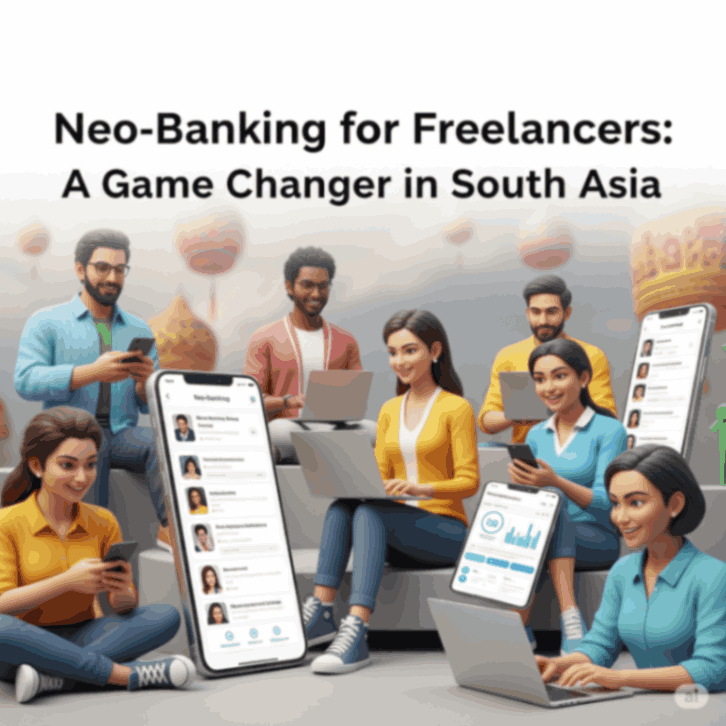
Freelancing is booming across South Asia, with millions of individuals offering services online in fields like writing, development, design, and digital marketing. Despite this growth, traditional banking systems often fail to meet the unique needs of freelancers.
Enter Neo-Banking — a financial revolution built for the digital age.
Neo-banks are emerging as a lifeline for independent professionals, offering flexible, digital-first financial services that cater specifically to their lifestyle and income patterns.
Understanding Neo-Banking
Neo-banks are digital-only banks that operate without physical branches. They provide financial services through mobile apps and websites, offering a seamless experience with lower fees and faster services.
Unlike traditional banks, neo-banks:
-
Have no physical branches
-
Offer 24/7 app-based banking
-
Focus on user-centric design and fintech integrations
-
Provide customized services for freelancers, gig workers, and startups
Trusted sources like McKinsey & Company highlight how neo-banks are transforming the global banking landscape — and South Asia is no exception.
Challenges Faced by Freelancers in South Asia
Freelancers in South Asian countries like Pakistan, India, Bangladesh, and Sri Lanka face several financial hurdles:
-
Lack of International Payment Access: Many banks don’t support platforms like PayPal or Stripe.
-
High Transaction Fees: Wire transfers come with steep costs.
-
Limited Credit Options: Most freelancers struggle to get loans or credit cards.
-
Unreliable Tax & Invoicing Tools: Freelancers often manage income manually.
-
Slow KYC & Onboarding: Traditional bank accounts can take weeks to open.
These issues create a frustrating financial experience for freelancers, affecting cash flow and credibility.
How Neo-Banking Solves These Challenges
Neo-banks are designed to support flexible income and digital business models. Here’s how they help:
-
Quick Onboarding: Fully digital KYC process allows account opening in minutes.
-
Global Payments Support: Integration with Payoneer, Wise, and PayPal alternatives.
-
Expense Tracking & Invoicing: Built-in tools to generate professional invoices.
-
Low Fees: Minimal or no charges for currency conversion and transfers.
-
Credit for Freelancers: AI-driven risk models help assess freelance income for loans.
These features provide freelancers a smoother financial experience and enable them to focus more on work than managing money.
Top Neo-Banks for Freelancers in South Asia
| Neo-Bank | Country | Key Features | Link |
|---|---|---|---|
| Zindigi | Pakistan | Instant payments, multi-currency wallets, digital onboarding | zindigi.com.pk |
| Fi Money | India | Smart savings, integrated UPI, rewards on transactions | fiy.money |
| Maya | Philippines (expanding in South Asia) | Freelance payments, low-fee transfers | maya.ph |
| Wise | Global | Transparent fees, multi-currency accounts, Payoneer-friendly | wise.com |
| Payoneer | Global | Preferred by freelancers for receiving international payments | payoneer.com |
These platforms are already serving millions and seeing increased adoption among remote workers.
Features to Look for in a Neo-Bank
When choosing a neo-bank as a freelancer in South Asia, prioritize the following:
-
Multi-Currency Support
-
Integration with Freelance Platforms (e.g., Upwork, Fiverr)
-
Instant Payouts
-
Tax Estimation and Invoicing
-
Security & Compliance
-
Mobile-First Interface
-
Customer Support Availability
-
Credit Line or Micro-Loans
These features ensure freelancers can operate smoothly in a global marketplace.
Why South Asia Is Ready for Neo-Banking
Several factors make South Asia fertile ground for a neo-banking revolution:
1. Growing Gig Economy
South Asia is home to over 10 million freelancers, especially in IT, content, and marketing. The region ranks among the top in freelance earnings globally (Payoneer Global Gig Economy Index).
2. Youth-Driven Workforce
A young population, high smartphone penetration, and increasing digital literacy are boosting fintech adoption.
3. Fintech-Friendly Policies
Countries like India and Pakistan are investing in digital ID systems, open banking, and RBI/State Bank of Pakistan-backed fintech licensing to encourage innovation.
Comparison Table: Traditional Banks vs Neo-Banks
| Feature | Traditional Banks | Neo-Banks |
|---|---|---|
| Account Opening Time | Days to Weeks | Minutes |
| Physical Branches | Required | Not Required |
| International Payments | Limited | Widely Supported |
| Invoicing Tools | No | Yes |
| Credit Assessment | Salaried-Based | Freelance Income-Based |
| App UI/UX | Outdated | Modern |
| Fees | Often High | Competitive |
Frequently Asked Questions
Q1: Are neo-banks safe for freelancers?
Yes, most neo-banks operate under financial regulations or partner with licensed financial institutions. Always choose platforms with 2FA, encrypted data, and trusted partnerships.
Q2: Can I use neo-banks to receive payments from Upwork and Fiverr?
Yes, platforms like Payoneer, Wise, and Fi support payouts from major freelance sites.
Q3: What documents are needed to open a neo-bank account?
Typically, you only need:
-
Government-issued ID
-
Selfie or biometric verification
-
Proof of address (sometimes)
Q4: Do neo-banks offer loans to freelancers?
Some do. Neo-banks use AI-based credit scoring systems that evaluate your freelance earnings and transaction history, unlike traditional banks.
Q5: How do neo-banks help with taxes?
Many neo-banks offer automated tax estimations, categorized expenses, and downloadable transaction history ideal for yearly filings or audits.
Conclusion
The rise of neo-banking is redefining how freelancers in South Asia manage money. With seamless onboarding, global payment integrations, and freelancer-specific features, these digital-first banks empower users to take control of their finances.
For freelancers in India, Pakistan, Bangladesh, and beyond, switching to a neo-bank could mean faster payments, lower fees, and greater financial independence.